
Heraldic Titles, Proficiency, and Ranks
Introduction
This article expands on the concepts in Basic Heraldry 101: The Herald, which reviews the history and roles of a herald and the College of Arms. If you are unfamiliar with these terms, please review BH101 before continuing.
The College of Heralds (COH) is comprised of heralds of varying ranks and proficiencies. You may hear or see some with funny names following their given name, or even referred to without their name, but instead as some creature, symbol, thing, or place. This is a practice stemming back from the earlier days of the College of Arms and are called heraldic titles.
HERALDIC TITLES
There are two types of titles available to heralds – the first is an office or staff title, also known as a “fixed” title (in that it is fixed to a heraldic office). This type of title passes among individuals to use during their term in said office. The other is a “personal” title, one that belongs to the individual in perpetuity. The latter is granted to those within the Society who have reached the proficiency of Herald Extraordinary, and is rare.
Examples of Office/Fixed titles in Caid are: Crescent (Caid Principal herald), Golden Rose (Court herald), Dolphin (Submissions herald), and Trident (Calafia Branch herald), among others.
Examples of Personal titles you may hear in Caid are: Chevron (Hrorek Halfdane of Faulconwood), Batonvert (Bruce Draconarius of Mistholme), Gold Starre (Eridana Ambra Dragotta), Pilgrim (Mary Dedwydd verch Gwallter), Espada (Ottavio Corsi), Mash Rake (Paul fitz Denis), and others.
HERALDIC DISCIPLINE RECAP
In regards to heraldic rank in the Caid COH there are three areas of heraldry in which a herald can have proficiency – book, field, and court.
Book heraldry includes research and aiding in submissions for both armorial and onomastics, as well as heraldic display and vexillology.
Court heraldry includes planning and performing court, and studies regarding protocol and the Order of Precedence.
Field heraldry includes making announcements, providing round introductions during tournaments, town cries, and general List Coordination.
HERALDIC PROFICIENCIES
Before we talk more on ranks, it is important to review heraldic activity proficiency, as the two are interrelated. In Caid there are four levels of proficiency that a herald can hold: none, basic, advanced, and mastery. Most of the verbiage below is borrowed directly from the Caid Herald’s webpage on Rank and Recognition.
None – learning
Those first entering into the world of heralding have zero to very limited experience or knowledge of heraldry as it pertains to the SCA, but instead have the desire to learn and participate.
Basic – participating
Those heralds with some experience and who can actively participate in an activity with very few or minor mistakes have basic competency. They may require guidance on a more complicated detail, but can handle the “bare bones” of that activity.
- Book – To function as an effective member of a heraldic consultation table, including a basic understanding of armorial rules (tincture, etc.) and period style, to navigate the Rules for Submissions, to research a name with sources listed in Appendix H of the College of Arms’ Administrative Handbook, and to do basic conflict-checking.
- Court – To successfully run a simple court, including an understanding of the pace and flow of a court: to collect and organize court business, to communicate with the titular heads of the court, to maintain poise and confidence in representing the Heads of State, to improvise when faced with unscheduled or unexpected changes to business smoothly and effectively, and to report court business to the Keeper of the Order of Precedence in a timely fashion.
- Field – To hold a field and run successive rounds from memory, to pronounce the fighters’ names with some degree of skill, to be heard from across the field, and to mark the list cards correctly.
Advanced – managing
Heralds who have advanced competency are those with longer and broader experience, and who can successfully arrange, direct, and adapt to impromptu challenges of that activity. They may not yet be an expert, but they can direct others in the activity with a large degree of accuracy on the more complicated details.
- Book – To handle all aspects of basic competency, to organize and run a consultation table, to know how to judge the reliability of sources not listed in Appendix H of the College of Arms’ Administrative Handbook, to conflict check with a high degree of accuracy, and to know how to write an appeal, a request for reconsideration, and a request for a regional style exception. Advanced competency in book heraldry does not require equal knowledge and skill with names and armory; basic competency is acceptable in one of the two areas.
- Court – To handle all aspects of basic competency, to run a large court, such as Coronation or Grand Court at a war, to understand the rules of etiquette and protocol to place multiple Royals and Representatives on a dais, to work with local heralds to hand off from Royal to Baronial courts, and to seamlessly integrate unscheduled business into court.
- Field – To handle all aspects of basic competency, to work with the Lists officer to arrange for the Order of Combat, and to recruit and assign other field heralds, etc.
Mastery – mentoring
A Herald who is an expert in a subject or area, or at the very least extremely competent and respected by heralds in their Kingdom and across the Known World alike, probably has Mastery proficiency. Mastery of a topic is hard to define – usually this means that one is the “go to” person in that discipline, and they make very few mistakes on even the most complicated details.
An excellent example in Caid of a herald who is considered a master of an area would be Bruce Draconarius of Mistholme. Master Bruce, along with Ottavio Espada, penned and continues to maintain the Pictorial Dictionary of Heraldry: the collection of emblazons of charges that are documentable to period sources and are acceptable for use within Society registrations. Each entry also contains the period source along with a brief history of the charge and some selected examples of Society registrations. Master Bruce also maintains a very active role in the College of Scribes, where he helps provide knowledge on how to incorporate heraldic elements into Scribal projects (his class on achievements is highly recommended!). To add to this, Bruce is well known across the entire Known World for often being the first to (accurately) reply to an armorial submission inquiry – so much so that to be beaten to reply first is to be “Bruced” by the person who replied before you.
Heraldic Ranks
As previously discussed in BH101, there is a difference between a “herald” and a “Herald” – the latter is a rank of proficiency while the former can refer to any person working in a heraldic capacity. Also, you may notice some heralds aren’t called Heralds at all, and are instead called something like Pursuivants or Macers. All of the these terms are designating the individual’s proficiency rank within the College of Heralds.
Macer – “the Apprentice”
The rank of “macer” is the default given to anyone entering the heraldic world. These individuals have a rudimentary idea of what the COH is, how it functions – mostly that it exists – and the general scope of heraldic aspects. They might have basic knowledge of one area, but are usually exploring any of the three fields. In other Kingdoms, this rank is also known as “cornet”. In context, a herald of this proficiency is a “macer”, but in conjunction with a staff title they would use “Macer.”
A macer isn’t usually found in a tabard, unless other regalia is not available. Instead, they wear a baldric or an escutcheon with the territory arms.
PROTIP: A macer was a messenger-at-arms employed as staff to both Garter and Lyon King of Arms. There still exists a Lyon Macer staff position in Scotland’s College of Arms, which is a senior Messenger-at-Arms position, but their main duty is to bear the mace of the court on judicial occasions. Note the difference in function (macer) versus Title (Macer) in this real world application!
Pursuivant – “the Journeyman”
A “Pursuivant” is a junior herald with the equivalent to a journeyman. These individuals have a basic knowledge in at least two disciplines, and are working on a third. Alternatively, they have advanced competency in one area and basic in another.
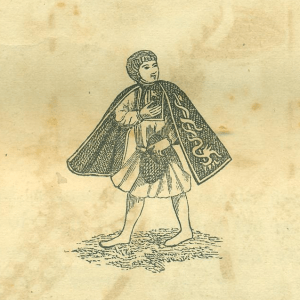
A pursuivant wears a tabard of the arms of the territory or person they served, however they would wear it “athwart” – with the chest and back pieces hanging over the arms, and the arm pieces over the chest and back.
Herald – “the Master”
A “Herald”, also called a Capital-H herald, is a herald with advanced knowledge of the College in at least two fields and working on a third; or mastery in one field, advanced in another, and working on a third.
A Herald wears a tabard of the arms of the territory or person they serve, as designed or intended. In Caid, they are also recognizable by wearing a silver medallion with the Seal of the College of Heralds (blazoned: “Tinctureless, A cross of Caid surmounted by two trumpets in saltire, a bordure embattled”).

Herald Extraordinary
A “Herald Extraordinary” is a herald who has achieved the highest proficiency (or Mastery) of heraldry and has greatly served the Kingdom or Society’s College of Arms. This is a relatively rare rank. At the time of writing, the Caid College of Heralds has 14 individuals who have been recognized with this rank since this rank was created in AS 16 by Wilhelm von Schlüssel, then Laurel Sovereign of Arms. It is granted to worthy recipients by Principal Heralds, and in Caid is done with the assent of the Crown. It also confers the recipient with a Personal Heraldic Title.
A Herald Extraordinary has no additional regalia or badges beyond the Herald. Instead, they are endowed with a new title of their choosing that is unique and permanent to them alone, as noted above.
PROTIP: A “herald-extraordinary” or “officer-of-arms-extraordinary” was used by medieval heralds to denote an individual that was hired (and paid) on a temporary or occasional basis. An individual who was hired for a permanent office, and thus received a regular a salary, were known as a “herald-in-ordinary” or “officer-of-arms-in-ordinary”.
Heralds of all rank can also be recognized while on duty by wearing the badge of the office, that is, a pair of crossed golden trumpets on a green field.
PUTTING IT ALL TOGETHER
Applying this knowledge, then, will depend a bit on context: what is the individual herald’s proficiency, and what staff position, if any, do they currently hold? You might notice here, that the herald does not use personal honorifics. This is because the herald eschews their personal honors when acting as a representative of the Crown. As such, they drop all personal titles outside of those used for their position, and instead use their COH title and proficiency.
For macers, Pursuivants, and Heralds, their rank would be used with the staff title in the same way. For example, the Trident officer for Calafia could be Trident Macer, Trident Pursuivant, or Trident Herald depending on the proficiency rank of that officer.
If an individual has the proficiency or rank as a Herald Extraordinary, they would only use that as part of the title when not in a titled staff role. That is to say, when they are only representing themselves, or working as a freelance herald, would it be appropriate to use “Herald Extraordinary” or use the abbreviation “HE”. In staffed positions they are a “Herald”, and would use the appropriate staff title. The use of “Extraordinary” is not required: a herald with this rank may drop this element in common usage.
The long form, and most formal means, of addressing a herald would be: [Full Name], + [Title] + [Rank]. As an examples:
- Ariana verch Gwenllian, Tyger Herald Extraordinary
- Ariana verch Gwenllian, Courtesy Herald **
- Ariana verch Gwenllian, Golden Rose Herald **
** Note the change in rank for this example: Tyger is a Personal Heraldic Title, whereas Courtesy and Golden Rose are staff titles. See below for more details on this practice.
A shortened version drops some of the name elements: [Given Name] + [Title] + [Rank]. As examples:
- Ariana Tyger Herald Extraordinary
- Ariana Courtesy Herald
- Ariana Golden Rose Herald
Another shortened and less formal version drops the rank: [Given Name] + [Title]. As examples:
- Ariana Tyger
- Ariana Courtesy
- Ariana Golden Rose
The least formal, and most familiar, form drops the Given Name to use only the herald’s title: [Title]. As examples:
- Tyger
- Courtesy
- Golden Rose
Any of these is a viable means of addressing a herald, or as a means of a herald addressing their own self (such as signing off on written correspondence).
PRO TIP: You may have noticed that in each of these instances, there is not mention of the herald’s personal awards and titles (such as Lord/Lady/Noble, or Baron(ess), or Master/Mistress/Sir/Dame). All personal accolades are dropped as the herald is acting in a professional capacity as an agent of the Crown.
So the next time you interact with a herald, try referring to them by their heraldic title!
Happy Heralding!
For further reading:
Eiríkr Gold Phoenix, What Did Heralds Wear?
Juliana Siren, Heraldic Titles from the Middle Ages and Renaissance: Overview
Caid College of Heralds, Caidan Policy on Heraldic Rank and Recognition
© 2024 Stephanie Rendt-Scott. All rights reserved. Limited publication rights may be granted upon written request to the author.
 Inn of the Tyger